

Writer: Nia T Hill
Director: Racky Plews
The confessional biopic has become the default way to tell a musical life, and the template was set the best part of a decade ago by Rocketman, the 2019 Elton John film that framed a career as one long session on the therapist’s couch, the past summoned up and reckoned with in flashback. I’m Every Woman: The Chaka Khan Musical borrows that device wholesale. We open with Chaka in therapy, wrestling with the drug addiction that has shadowed her, and from there she is pulled back into memory: a childhood home presided over by a mother who had as many children as she had husbands, and a father, himself a user, who walked out on the family when Chaka was still in her mid-teens.
From that beginning the show sets off on the journey of a lifetime, and it is quite a lifetime to work with. Through a long run of vignettes we watch the enthusiastic club singer become one of the most renowned voices in the world: an early marriage in Chicago, performing in a local band alongside a husband who played the bass, the meeting with Rufus, the record deal, the touring, the collaborations with Stevie Wonder, the friendship with Joni Mitchell, the second marriage to Richard Holland.
On it rolls, through tours with the Rolling Stones and with Stevie Wonder, through her transformation from featured singer in Ask Rufus to the act everyone had come to see, and out the other side into a solo career. There are early encounters with Whitney Houston and Luther Vandross, and later, more celebrated work with Prince, Steve Winwood and Robert Palmer, the latter ending with her vocal quietly stripped from his version of Addicted To Love for reasons that had nothing to do with the singing.
And beneath all the glamour, the harder story: two marriages laced with abuse, a hospitalisation for overdose, an arrest for shooting her husband, and a woman forever presented as chasing the career at the expense of the family, her eldest daughter left to grow up in something that looks a great deal like abandonment.
It is, by any measure, a remarkable life, and there is a genuinely powerful piece of theatre buried somewhere inside it. The tragedy of the evening is that the show squanders almost every chance to find it. There is no structure to speak of; we are handed a string of scenes that carry us from the Black Panthers to the present day, and not one of them builds on the last. Worse, none of them builds an emotional heart. You are teased with the outline of a dramatic, tumultuous, extraordinary story, and then left to assemble it yourself from the fragments scattered across the stage.
The music, at least, is decent, and the band is very good indeed. The vocal performances are a more mixed affair. Chaka Khan has one of the most singular voices in popular music, and it is not a sound Alexandra Burke manages to capture, though she copes with the demands of the singing perfectly well; the supporting voices around her are more variable still.
The acting is adequate to most of what is asked of it. The real culprit is the writing. The script offers no thread to hold on to, and it is so stuffed with platitudes and post-modern motivational aphorisms that it begins to feel like a rack of Hallmark cards read aloud. Lines such as “an angry man is an angry man, but an angry woman is a bitch,” or “they may take my vocals but they will not take away my voice,” or “I didn’t leave to get away from you, but to find myself,” are strewn throughout, and every one of them rings so false that it chips away at whatever narrative the show is trying to build.
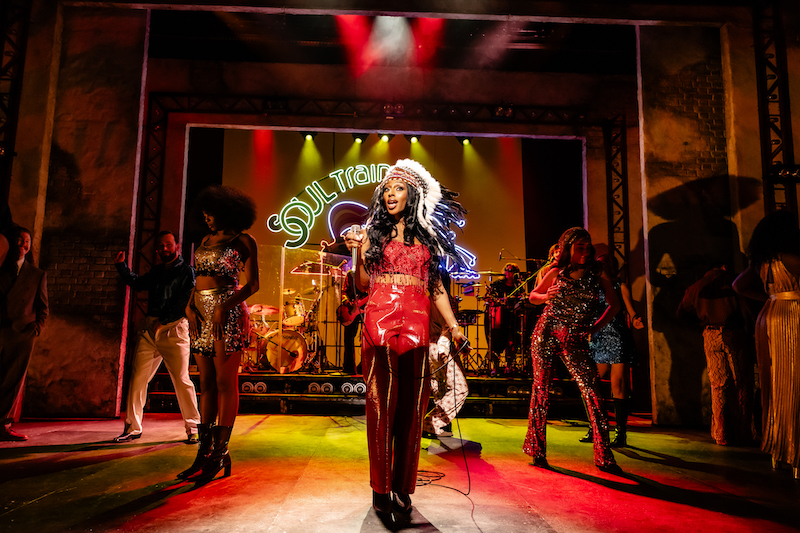
Where the evening genuinely comes alive is in its design. Sara Perks’s set is a wonder, a visual marvel that carries us through the eras with real invention: a Chicago club one moment, the poolside of a mansion the next, then the Grammy Awards, then the psychiatrist’s office and beyond. A sliding door doubles as a screen for projection and coupled with a huge LED backdrop, the whole thing is a feast for the eyes.
The costumes match it, tracing Chaka’s life through every change of decade. The choreography is a good deal less assured, a touch hammy and self-consciously of its period, fun to watch but never memorable. Some of the performances tip over too: the depiction of Prince is such an exaggerated caricature, played for laughs, that it never lands the way it ought to.
Then there is the strange decision to lavish so much time on figures orbiting the story rather than the story itself. The extended sequences given over to Miles Davis and Joni Mitchell, and the recording scenes with Whitney Houston and Luther Vandross, play as distractions from the woman we have come to see. Cut half of what is on offer here, train the focus squarely on Chaka’s own life, and this would have been a far more revealing and engaging night. As it stands, you leave wanting to know more about her and feeling faintly cheated that you were not told it.
The handling of the music is its own peculiar failure. The score threads Chaka’s own catalogue through the hits of the surrounding time, with the covers doing the work of setting a scene and nudging the narrative along. Yet the two songs the audience most wants, I’m Every Woman and Ain’t Nobody, are handed to other characters, so this Chaka never actually delivers her own signature numbers, and a scattering of further songs feels bolted on for the sake of completeness. Everywhere you look, there is the tease of something great that never arrives.
The money is plainly on the stage; you can see it in the design, and you can feel it across a running time of very nearly three hours. It is an expansive, expensive show. But the venue is oddly cavernous, more concert arena than theatre, and the sound simply refuses to bloom in the space; it falls dead. For all the strength of the combined vocals and playing, the evening lands flat in the auditorium, and the arena-like staging leaves you strangely distant from the action, which is precisely what you do not want in the theatre.
Chaka Khan’s life and legacy deserve so much more than this. The show could yet deliver it, if only it found an anchor and followed the thread through, rather than offering up this polaroid, whistle-stop dash through a life that merited proper telling.
Runs until 27 September 2026
