

Writer: David Ireland
Director: Harry Burton
Subtle in content and punchy in delivery, this timely, viscerally funny reiteration of David Ireland’s searing 2009 debut, written as the Belfast actor struggled to make headway in his acting career, lays bare the ways in which sectarianism shapes, hinders and propels those subjected to it.
Set in a waiting room for the Stranraer ferry and a claustrophobic venue in Belfast, the action arises from dialogue between unintentionally reunited classmates at pivotal points in their careers. Jimmy Culver’s an actor on the verge of movie breakthrough, and Eddie Harrison’s a successful footballer, the surprisingly Protestant captain of Celtic.
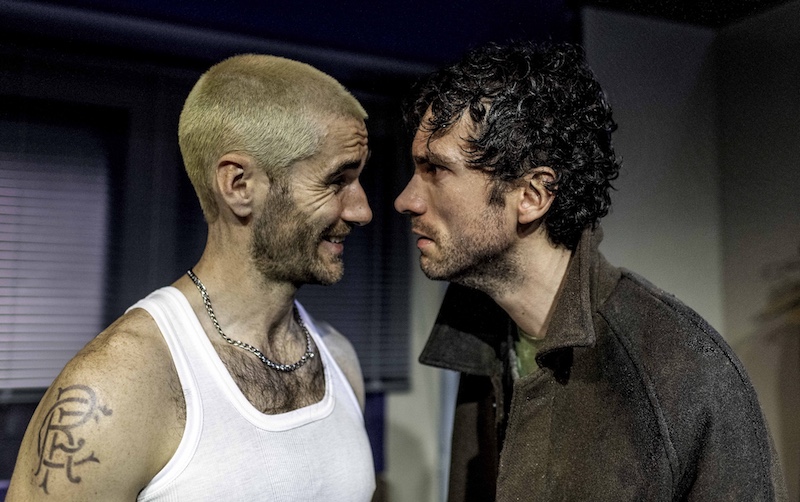
Matthew Blaney as Jimmy, low-key and earnest as he quietly reads through a script in his Withnail-style charity shop coat, initially delivers disapproving condescension and repeated side-eye towards loutish, flashily-clad bottle blond Eddie (Robbie Martin), who reels out homophobic and ableist views in a blaring mobile call and attempts to light up in the non-smoking zone.
Jimmy is then wrong-footed on his high ground as Eddie de-sunglasses and reveals himself as his high-flying Premiership ex-school friend, forcing Jimmy to revert, momentarily to his former sportive ranking, somewhat down the pecking order. Eddie’s footwork-fuelled ease in his trajectory through life makes a mockery of Jimmy’s sincere but going nowhere studiousness.
Their teen memories and current perceptions of each other vary widely, hilariously and colloquially, as Eddie labels Jimmy “a Hun” (Loyalist Rangers fan), and shows disarming awe at his acting talent. Jimmy’s shocked at Eddie’s racist takes on invasive Poles – “Sure, they’re all over here now” – and African footballers playing in the UK, and nearly leaves, until Eddie apologises and starts asking about Jimmy’s upcoming audition.
It turns out they’re both attempting to escape Glasgow: “It’s so depressing,” says Eddie, “Like Belfast only more sectarian.” Jimmy’s in the running for Mel Gibson’s movie about the Troubles, Sins of the Fathers, and Eddie’s in talks to transfer to LA Galaxy, where he’s hoping to go “destroying these Mickey Mouse American sides” and “bucking all round” with his bestie ex-teammate David Beckham.
Mightily impressed by the mention of Mel Gibson, Eddie tries to co-opt Jimmy into a night on the drink with his mates, and the scene ends with the feeling that Jimmy’s back on top.
The balance of power swings wildly in the second half as events take an extraordinary turn and both protagonists find themselves asserting their dominance in increasingly physical and violent ways. The foregrounding of Mel Gibson’s historical revisionism is very apt, and a means of showing the ways in which events and identities can be distorted by time, distance and prejudice. Gibson is the perfect totem for this play.
Jimmy and Eddie reach for the grab bag of nationalistic and sectarian ideologies to lob as missiles at each other, tie themselves and each other up in contradictory knots, and switch sides and perspectives as it suits their arguments. What starts with Jimmy confidently projecting his acting prowess by effortlessly quoting Hamlet proceeds to balaclavas and combat, while both players continue to elicit belly laughs with their increasingly deranged repartee.
It’s Eddie’s wilfully uneducated idiocy that supplies the most comedy. Real skill is required to portray a dimwit, and Martin excels at it. He also captures the character’s inherent honesty, innocence and confusion about the world.
The most impressive aspect of Blaney’s performance as Jimmy, in addition to his winning way with a one-liner, is the way in which he goes the gamut from cowed to ferocious: a peaceful man provoked beyond reckoning.
The play is impeccably staged. Alex Marker’s spare but efficient set reflects the Spartan masculinity of the play, and makes creative use of the limited space, flipping seamlessly between scenes to produce an entirely new venue. The move is made more convincing by Joe Dines’ moody, evocative soundtrack – ship horns; thunder; wild music – and Jodi Rabinowitz’ moody lighting, especially effective in the stormy second half.
Despite dating from 2009, the play’s reference points are still surprisingly robust. Happily, everyone still knows who David Beckham and Jimmy Nesbitt are, and Eddie’s brutishness now has a name: toxic masculinity. The well-defined Northern Irish brogues never render the dialogue incomprehensible, the torrent of swearing seems entirely apt, and the few indigenous words (like ‘taig’: Irish Nationalist) and phrases are easy to understand in context.
There’s reluctance in the UK to dwell on Northern Ireland’s controversy, conflict and pain, but this is becoming increasingly necessary as Sinn Féin pushes for a unification referendum by 2030, and outnumbered Protestants become more vocal (the Orange Order is currently attempting to re-assert its marching route down the largely Nationalist Garvaghy Road in Portadown).
Strikingly relevant in light of these recent events, What The Animals Say offers an entertaining and palatable primer of the forces at play in Northern Ireland, and a reminder of the dangers of allowing prejudice and faction fighting full sway in this increasingly adversarial era.
Runs until 24 October 2026
